

Chapter 1
George was a very loving little boy. He loved animals, particularly dogs, and from a very young age he was fascinated by anything with wheels. Looking back, I think I probably noticed that George was different from other children very early on.
George was quiet, particularly in groups. and was more comfortable spending time with animals than joining in with the other children.
At school, George had a very small circle of friends — just two or three children he felt comfortable with. He didn't need or seek out a large group of friends; he was happiest with the people he knew and trusted. George was the quiet child who never caused any trouble, he was well behaved and got on with things. Looking back, though, I think he was often working hard just to process what was happening around him.
Food was difficult. Clothes were difficult. He would become very attached to particular things — I had to buy the same trousers in different sizes because he was comfortable with them and didn't want something different. He was also incredibly attached to three particular cuddly toys.
At the time, these things were just George being George. George was growing up differently from other children, and I adapted around him without necessarily understanding why. He lost the final two years of primary school to COVID, which also meant that some of the normal experiences of childhood and the transition towards secondary school were disrupted.
It wasn't until George started secondary school that the difficulties became impossible to ignore.
Chapter 2
George started secondary school hopeful, but almost instantly he was terrified. I knew he had always found social situations difficult and that he experienced the world differently, but had no idea just how much the transition to secondary school would affect him. The mornings became incredibly difficult. Getting George to school became a daily struggle, and when he came home, evenings were spent trying to mend what felt like a broken spirit.
George became quieter and quieter. The little boy I had known seemed to be disappearing in front of me. In less than a year, he had lost his self-confidence and his belief in himself. He was mentally destroyed.
George also experienced bullying at school, and its impact went far beyond the school gates. He became frightened of seeing the people who bullied him, to the point that he wouldn't go into the town centre in case he came across them. He became increasingly withdrawn and introverted. Rather than talking about what was happening, George became quieter, which made it incredibly difficult to understand just how much he was struggling.
And there was another difficulty that I didn't fully understand at the time.
George couldn't easily identify or explain his own emotions.
He couldn't simply tell me, "I'm anxious," or "I'm frightened," or "I'm overwhelmed." Often, he didn't understand what he was feeling himself.
We had to find different ways of helping communicating what was happening inside him. One of the things was a scoring system, where George could give a number to how he was feeling when he couldn't find the words. It might sound like a small thing, but it became an important way of communicating with a young person who often couldn't explain his emotions in the way other people might.
By the beginning of Year 8, George was in pieces. I remember him sobbing and knowing that something had to change. I had a meeting with his Head of Year, who told me that I needed to take George out of school to protect his mental health.
So I did.
At the same time, George was dealing with extremely difficult circumstances within his family. George made the decision that he no longer wanted to go to his dad's house. Eventually facing the incredibly difficult position to have no further contact with his father. For a young person who already struggled to understand and communicate his emotions, this was an enormous amount to process.
Taking George out of school didn't suddenly make everything better.
For a period, George became extremely withdrawn and almost completely room-bound. As puberty arrived alongside the difficulties he was already experiencing with autism and the impact of bullying, his world became smaller and smaller.
George was unable even to go downstairs on his own. This was a huge distance from the little boy I remembered. The child who had loved animals, adored his dogs and been fascinated by anything with wheels was now struggling to leave his room. For several months, life became about getting George through each day and giving him a safe environment in which he could begin to recover. And slowly, I started to see a glimmer of the George I had known before secondary school. It wasn't a sudden transformation.
There was still a huge amount of work to do. But he was beginning to come back.
And that became my next challenge:
How do you rebuild the confidence and self-belief of a child who has been made to feel that he doesn't belong?
I knew I couldn't simply put George back into the world and expect him to cope.
I needed to help him understand himself, understand what he needed and, most importantly, believe in himself again.
Chapter 3
By this point, I was desperate to find something that would get George out of the house. He had become so withdrawn that his world had become incredibly small. I wasn't looking for a career for him or trying to find a hidden talent. I just wanted to find something he might enjoy — something that would give him a reason to leave his room and experience something outside the four walls that had become his safe place.
I'd always liked Formula 1 and racing, and earlier that year we had been karting for a friend's birthday. George had enjoyed it, and he already loved sim racing, so I wondered whether actual karting might be something he would be interested in.
So we went to Teamsport Coventry.
George was always reticent about leaving the house, but he was willing to try it.
And then something happened that I hadn't seen for a very long time.
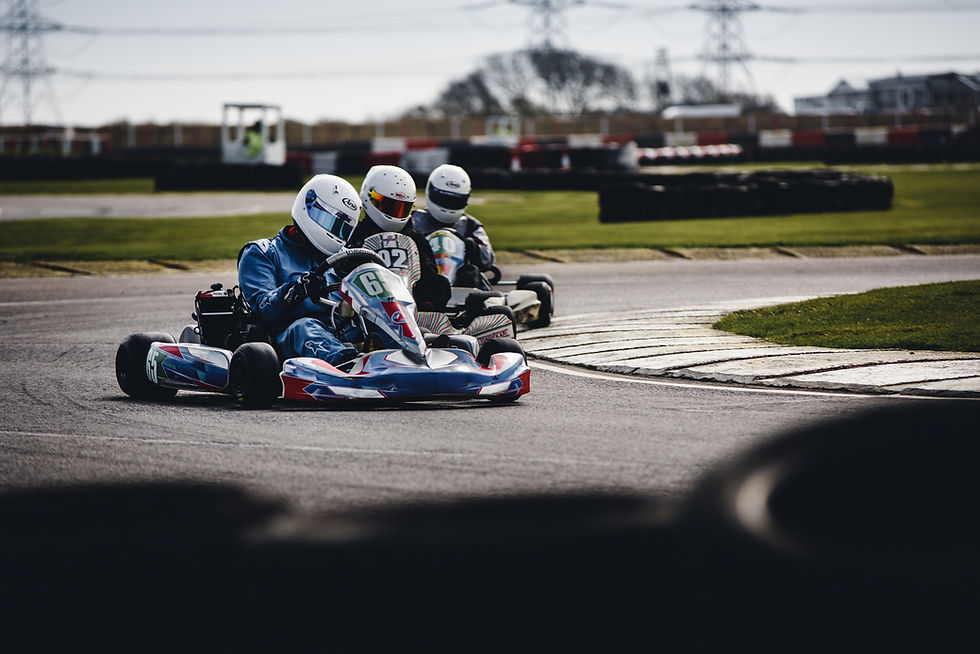
The moment George got into the kart, he changed. He wasn't brilliant straight away. He wasn't suddenly the fastest person on the track. But something about being in that kart made him completely different.
He was calm.
He was focused.
He was content.
It wasn't the old George — that is still a long way away — but it was a step forward.
The track wasn't particularly busy that day, and the staff were lovely. That helped enormously. George had found somewhere that didn't feel overwhelming, and for perhaps the first time in a long time, I watched him completely absorbed in something.
Afterwards, he talked about it constantly. The staff suggested that he join the Race Academy, and George wanted to go back.
Then he wanted to go back again.
And again.
Very quickly, he wanted to be there almost every evening.
He didn't want to not be in a kart.
For me, that was incredible.
I had spent so long trying to find something that could bring a little bit of happiness back into his life, and suddenly here was something that he genuinely loved.
I wasn't thinking about championships.
I wasn't thinking about sponsorship.
I wasn't even thinking about whether George was particularly good.
I had found something that gave him a reason to get up.
George began visiting regularly during 2024 and started doing surprisingly well. There was one night in particular that I will never forget. It was the night George decided that he wasn't going back to his dad's house.
It was an incredibly difficult night for him, and we went to the kart track. Somehow, despite everything that was going on, George got into the kart. And he broke into a 39-second lap.
At the time, only seven people had managed to get down to that sort of time.
It was one of those moments where I started to think:
Maybe George is actually good at this.
Later that year, George decided he wanted to enter the British Indoor Karting Championship. He did incredibly well in the local events and continued to perform strongly at the regional level. He was at the top of every race at regionals until the final, when another driver took him out. That driver subsequently received a penalty, but for George, the damage was already done. He sobbed.
And that moment also showed me something important about George. Because although he was becoming increasingly confident and competitive in the kart, he hadn't suddenly become a confident teenager everywhere else. Wherever we went to race, George was still the incredibly insecure young boy I'd been trying to help rebuild.
The difference was that when he was sitting in a kart, I didn't see that boy.
Away from the track, George would often wait in the car rather than go inside. At indoor tracks that had a quiet room, he would sometimes sit there and hide away from the noise and the people. Then, when it was time to race, he would get into the kart. And everything changed.
The kart became his safe place.
It was somewhere he understood.
There were rules.
There was a clear beginning and end.
He knew what was expected of him.
And, most importantly, he was good at something.
For a young person who had spent years being made to feel that he wasn't good enough, that mattered more than I could possibly have understood at the time. I didn't know it then, but that first visit to Coventry was going to change the direction of George's life. We had gone there because I was trying to get my son out of the house.
We left having found something that made him want to come back.
And eventually, we discovered that he could race.
Chapter 4
Karting hadn't suddenly changed everything for George. Away from the track, he was still the same anxious, insecure young person who found everyday life incredibly difficult.
He still didn't want to leave the house.
Unless he was going karting.
That was the difference.
The confidence I'd started to see in George existed almost entirely when he was at the track. But I began to realise that perhaps the important thing wasn't that karting was making him confident everywhere else. It was that karting had given him somewhere he felt confident at all and gave him a reason to be.
When George was in a kart, it was as though everything made sense.
He understood the kart.
He understood the racing line.
He understood braking points.
He understood the maths and the science behind what he was doing.
There were rules. There was logic. There was a clear purpose.
And he was good at it.
For perhaps the first time in his life, I watched George doing something where he didn't seem to be constantly trying to work out what everyone else was doing. He just belonged. And that became even more obvious when we discovered that Teamsport offered a Level 1 Mechanics course. George was very apprehensive about the idea of studying. His previous experiences of education had been incredibly difficult, so the thought of attending a course was a huge step. But this was different.
It was at the kart track.
It was a very small group.
And he would be learning about something he genuinely loved.
The course was going to cost more than £3,000, and because George can't use public transport, getting him there would also mean around £240 a month for an Uber. It was a huge financial commitment. But I genuinely believed that George was able to attend that course because it was taking place in his safe place.
He loved learning about the kart.
He was interested.
He was engaged.
And, perhaps most importantly, he wanted to be there.
That was something I hadn't been able to take for granted with education. Karting hadn't made George suddenly comfortable in the world. But it had shown us that when the environment was right, George could learn. And that became something I couldn't ignore. It wasn't supposed to become a career. Even now, I don't think of karting as some carefully planned career pathway. It wasn't. I didn't discover karting and immediately decide that George was going to become a professional racing driver. But it did open our eyes to possibilities that we hadn't previously considered.
Mechanics.
Engineering.
Motorsport.
Technical roles.
Things that might actually play to George's strengths. And perhaps that was one of the biggest things karting gave us.
It gave us a glimpse of what George could do, rather than constantly focusing on what he couldn't. There was still a huge difference between George at the track and George everywhere else.
He still struggled enormously with emotions.
He still struggled socially.
He still couldn't simply walk into a busy building and feel comfortable.
During this period, there was also a huge amount happening within our family. George's sister was fighting anorexia, and home life was incredibly difficult. There was a lot going on, and George was still trying to navigate his own challenges.
The kart track became his space. A place where he could escape everything else for a while.
A place where he wasn't the boy who struggled to communicate.
He wasn't the boy who couldn't cope with busy environments.
He wasn't the boy who had struggled so badly at school.
He was George.
The driver.
Gradually, I started to see where this might take him. Initially, we tried to join a team. I put £10,000 of an inheritance I had received into it, hoping that this might give George the opportunity to develop his racing. It was a huge amount of money for us. And eventually, I realised that I simply couldn't afford to own and run a kart ourselves. I was recommended to look at Club100, and in 2025 we started that journey.
That inheritance had come from my uncle. And I couldn't help thinking that if he had been here to see George now, it would have meant so much to him. Because after everything George had been through, he was finally beginning to live again.
Not everywhere.
Not all the time.
But at the track.
And for me, that was worth all the financial sacrifice.
We had no idea where Club100 would take us.
We weren't thinking about World Finals or championships or sponsorship.
We were simply following the one thing that had made George want to get out of the house.
And, for the first time in years, I wasn't just trying to help George survive the world around him. I was watching him begin to find a place within it.
Chapter 5
2025 was the year that karting became something very different.
George had spent the previous year discovering how much he loved being in a kart. He had found something that made him calm and focused. Now he was going to find out what happened when he started racing outdoors.
We entered George into Club100, and his first race was at GYG in April 2025. GYG is an incredibly beautiful venue, but the racing was a completely different world from the indoor karting George had become used to.
The speed was faster.
The racing was more aggressive.
And there was a lot more to think about.
One of the biggest challenges was something that might seem incredibly small to most people: the rolling start.
George still struggles to judge his position and the space around him during rolling grid starts. He finds it difficult to accurately count the gaps between the karts, and this often means that he ends up several places further back than where he should actually be starting.
For most drivers, this might be a minor inconvenience.
For George, it was another layer of information to process while also trying to race.
At GYG, the speed and aggression of the racing were a huge shock.
George made it through to the B Final and finished ninth.
The next opportunity came at Shenington. George had initially been on the reserve list for Club100 South, and when a space became available he was able to race. Again, he raced well enough to reach the B Final. But the racing was tough. He was knocked around repeatedly and eventually dropped towards the back of the field.
For George, this wasn't simply frustrating.
It was overwhelming.
He was upset and left the track early.
There was a lot to learn.
And slowly, he started to learn it.
George ended the year
24th in Club100 South26th in Club100 North
Champion in Club100 Experience Championship.
There were some brilliant moments throughout the season.
He won at Bayford.
At Lydd, he was the top rookie.
And there was a particularly memorable B Final at PFI.
But the final race of the Experience Championship is the one I will never forget. The championship had come down to two drivers. George was starting from pole, but the driver in second could still win the championship if he overtook. At the start, the driver behind hit George quite hard and was given a penalty. But the race wasn't over. For the entire race, the two drivers traded places. George crossed the finish line in second. He didn't know he'd actually won. Afterwards, he congratulated the other driver. The other driver told him that he had received a penalty. George put his helmeted head into his hands and sobbed. He was completely overwhelmed. But this time, they weren't tears of disappointment.
He had won the championship.
For a young person who had spent so long struggling with confidence and self-belief, watching George experience that moment was incredible. He still hasn't quite mastered starting in the correct position during rolling starts. But he had learned how to race. And, more importantly, he had started to believe a little bit in himself
British Indoor Karting Championship 2025Alongside Club100, 2025 was also George's second year competing in the British Indoor Karting Championship.
This was the first time that we felt some pressure around it. George really wanted to get through the local rounds because he had managed to do it the year before, and that had been such an incredible achievement. But we didn't have the time or money to put a huge amount of practice into the regional events. We could only visit the track twice.
So when George managed to get through the regionals and qualify for the national final, it was an enormous surprise.
We decided that we needed to practise for the national final because George was unfamiliar with the track. So I took George and another driver up on Monday nights, while another parent took them on Thursdays. It was exhausting.
We would get home at around 2am, I would get up at 6am to go to work, and for the rest of the week I was finishing teaching at around 8:30pm.
Exhausting doesn't really cover it.But I wanted to give George the best chance we could.
Then we reached the week of the final.
And George simply imploded.
On the Monday night, he shut down. He couldn't go. I had booked an apartment for Thursday and Friday so that we could stay near the venue and reduce the travelling, but George was overwhelmed and defeated. On Thursday night, he was picked up and taken to Warrington. I had a horrible feeling that things weren't right. I finished teaching, got in the car and started driving towards Warrington. When I arrived, George came out of the front door, almost fell into the car and just sobbed.
He was fifteen years old.
And he was completely crushed.
He held my hand in the car all the way home.
I told him we would leave at 4pm on Friday. When I got back from work, he couldn't go. So I reminded him that if we weren't leaving Friday evening, we'd have to leave at 6am the next morning. And I am still amazed that, at 6am, George got up and was ready to go. He had needed that time to recover. His cats have always been incredibly important to him and help to ground him, so spending time with them helped him find himself again.
And somehow, we went. The building was horrendously busy. George had a little room where he could hide away.
But when it came time to race, he did what George does.
He got in the kart.
He qualified alongside the top drivers for the Grand Final.
And he finished 12th nationally
It was just insane.
George was pleased with his performance. I think he was proud of himself too. And he should have been. Because what people saw was a fifteen-year-old boy competing against some of the best indoor karting drivers in the country. What they didn't see was everything it had taken to get him through the door.
Two different GeorgesOne of the hardest things to explain about George is that you can watch him racing and think he is just like everyone else.
On track, he is. But getting to the venue, waiting around, being around crowds, listening to briefings and dealing with everything that happens before and after a race could be incredibly difficult for him.
His body will often go into fight, flight or freeze.
He will sit in the car between races.
Briefings are always difficult, so we stay at the back. George can't visualise the track from the briefing, so afterwards we talk through everything together.
Crowds and people are still incredibly difficult. Even stopping at a service station could be challenging.
He wasn't really socialising with the other drivers.
He wasn't walking around making friends.
He still needed me beside him all the time.
And he didn't always handle the anger and frustration of racing well.
There was still a huge amount of work to do.
But there were little changes.
Some of the Club100 staff were becoming familiar to him.
He was beginning to recognise people and feel comfortable around them.
And, slowly, I think he was beginning to believe in himself.
The awards dinner
Perhaps one of the most incredible moments came after the season had finished. George was invited to the Club100 awards dinner to receive his trophy. There were more than 300 people there.
And George wore a suit.That might sound completely ordinary.
For George, it was enormous.
He curled himself up as small as possible in his chair and sat between me and his auntie. He was overwhelmed by the room and the number of people. But when his name was called, he went onto the stage. And he collected his trophy.
I still can't quite believe he was able to do that.
This was January 2026.
The same boy who had once been unable to go downstairs on his own.
The same boy who could struggle to walk into a building.
The same boy who would sit in the car until it was time to race.
He stood on a stage in front of more than 300 people and collected a trophy for winning a championship.
It wasn't that George had suddenly overcome everything.
He hadn't.
But he had done something that once would have seemed impossible.
And that was becoming the pattern of George's life.
He would struggle enormously to get there — and then, somehow, he would do it.
Continuing into 2026By the end of 2025, George was desperate to carry on racing.
But there was a problem.
Money.
I was working two jobs, trying to keep the house going while supporting both children with their education and their interests.
I'd already put a significant amount of money into George's racing from the inheritance I had received from my uncle.
And now we had to work out how we could possibly afford another year.
There wasn't really an easy answer.
In the end, the only option I could see was to remortgage the house and release money to get George through 2026.
It wasn't a decision I took lightly. But by this point I knew what karting meant to George. And I knew what taking it away could mean. He had also been offered the opportunity to complete the Level 2 Mechanics course at Coventry, at another cost of around £3,000.
Karting had opened a door for George that we hadn't even known existed.
It had shown us that he could learn.
That he could compete.
That he could achieve.
And it had given us the first real glimpse of possible career pathways that might actually work with his strengths.
So, going into 2026, I made the decision to keep going.
I had no idea where the next year would take us.
I only knew that karting gave George a life!